Mowing steep slopes is fundamentally different from mowing flat farmland or lawns. The challenge is not simply whether the engine has enough power to rotate the cutting blades. On a slope, a mower must overcome gravity, maintain traction, remain stable on uneven ground and continue cutting vegetation under changing loads.
This is why a professional remote control mower for steep slopes needs to be designed as an integrated mechanical system. The crawler tracks, center of gravity, hydraulic drive, cutting system and remote control technology all influence how the machine performs in real agricultural conditions.
For professional agricultural machinery buyers, understanding these principles is more useful than comparing engine horsepower alone. A machine with a larger engine is not necessarily a better steep slope mower if its track system, weight distribution or power transmission cannot effectively convert engine output into useful traction.
This article explains the engineering principles behind remote control crawler mowers and why they are suitable for steep slopes, orchards, farms and difficult vegetation-management applications.
1. Why Is Mowing on a Steep Slope More Difficult?
On flat ground, a mower mainly needs to overcome rolling resistance and the resistance generated by the cutting system. Once the machine moves onto a slope, gravity becomes another major source of resistance.
When a crawler mower travels uphill, part of the machine’s weight acts against the direction of travel. As the slope becomes steeper, the required driving force increases. At the same time, the crawler must maintain sufficient contact with the ground to prevent excessive slipping.
This leads to an important engineering principle:
Engine power provides available energy, but traction determines how effectively that power can be converted into useful movement.
For example, increasing engine horsepower does not automatically solve a traction problem. If the crawler begins to slip on wet grass or loose soil, part of the available power is lost through track slip rather than being converted into forward movement.
This is particularly important for a remote control mower for hills, because agricultural slopes rarely have completely uniform surfaces. A machine may encounter dry grass, wet soil, loose earth and uneven ground within the same working area.
Therefore, professional slope-mower evaluation should consider power, traction and stability as one system rather than relying on engine output alone.
2. How Do Crawler Tracks Improve Traction?
The crawler system is one of the main reasons a remote control mower can work effectively on difficult terrain.
A conventional tire has a relatively limited contact area with the ground. A crawler track distributes the machine’s weight over a longer contact surface, which can reduce ground pressure and help maintain contact with soft or uneven terrain.
This characteristic is particularly valuable when a mower is working in orchards, on farm slopes or on wet grass where conventional wheeled equipment may experience reduced traction.
However, track width alone does not determine performance. Track geometry, tread design, machine weight, weight distribution and ground conditions all influence actual traction.
This explains why two machines with similar engine power can behave very differently on the same hillside.
From an engineering perspective, the crawler system is the connection between the powertrain and the ground. The engine and hydraulic system may generate substantial torque, but that torque is useful only when the crawler can transfer it to the ground without excessive slipping.
For buyers comparing a crawler mower for slopes, crawler design should therefore be evaluated together with the powertrain rather than as an isolated specification.
3. Why Is Center of Gravity Important on a Slope?
Another critical factor is the machine’s center of gravity.
The center of gravity can be understood as the point at which the overall weight of the machine effectively acts. On flat ground, the relationship between the center of gravity and the supporting area is relatively straightforward. On a slope, this relationship becomes much more important.
As the inclination increases, the vertical projection of the machine’s center of gravity moves closer to the edge of its supporting area. If the machine’s geometry and weight distribution are poorly matched to the terrain, stability can decrease.
This is why a compact machine with a relatively low center of gravity can sometimes be more suitable for slope work than a larger machine with greater engine power.
In simple terms:
Power helps a mower climb the slope. Stability helps it remain controlled on the slope.
For professional procurement, machine height, crawler width, component placement and overall weight distribution should therefore be considered together. This becomes especially important when the mower needs to travel across a slope rather than simply moving straight uphill.
4. How Does Hydraulic Drive Affect Slope Performance?
Hydraulic drive systems are widely used in professional crawler mowers because they can provide controlled torque and smooth power transmission under changing loads.
Slope mowing often requires relatively slow travel combined with high driving force. A mower does not necessarily become more productive simply by traveling faster. On difficult terrain, controlled low-speed movement can provide better cutting consistency and reduce unnecessary traction loss.
When the machine encounters a steeper section or a change in ground resistance, hydraulic drive allows the powertrain to respond to changing loads while maintaining controlled movement.
This is particularly useful when working around trees, uneven terrain and obstacles. Independent control of the left and right crawler systems also allows the mower to maneuver within a relatively small area.
For orchard operators, this maneuverability can be more valuable than maximum travel speed because the machine often needs to work between trees and follow irregular paths.
5. How Does the Cutting System Affect Mower Performance?
The cutting system creates another important working load.
Light grass generally requires less cutting force, while tall weeds, dense vegetation and tougher brush can significantly increase resistance at the cutting deck.
At the same time, a mower working on a slope is already using part of its available power to overcome gravity and maintain traction. The machine therefore needs to manage several loads at the same time.
This is why professional mower selection should consider the relationship between engine output, cutting width, vegetation density and operating speed.
A wider cutting deck can increase productivity by covering more ground per pass, but it may also require greater power when cutting dense vegetation. Simply choosing the machine with the largest engine does not guarantee better efficiency if the cutting system and transmission are not properly matched.
A well-designed agricultural remote control mower therefore requires a balanced combination of engine, hydraulic transmission, crawler system and cutting mechanism.
The goal is not to maximize one specification. The goal is to maintain stable performance under the actual working conditions.
6. Why Is Remote Control Important for Steep-Slope Mowing?
Remote control technology changes the safety relationship between the operator and the machine.
A conventional mower requires the operator to remain close to the equipment. On a steep slope, this can expose the operator to unstable ground, machine movement, rotating cutting components and flying debris.
A remote control crawler mower allows the operator to stand at a safer observation point while controlling machine movement and cutting functions.
This is particularly useful for roadside slopes, embankments, riverbanks, orchards and agricultural areas where the terrain may be difficult or unsafe for people to walk across.
It is important to understand that remote control does not physically increase the machine’s mechanical stability. Its primary benefit is that it separates the operator from the immediate working environment.
For professional buyers, the remote control system should therefore be evaluated as part of the overall safety design. Signal reliability, control response and emergency-stop functions are important when equipment is operating at a distance.
7. Does the Maximum Slope Angle Tell the Whole Story?
Not necessarily.
One of the most common mistakes when comparing a steep slope mower is to focus only on the maximum slope angle stated by the manufacturer.
In real agricultural applications, slope angle is only one variable. Surface conditions can have a major effect on available traction.
A mower operating on dry grass may perform very differently from the same machine working on wet grass after rainfall. Loose soil, mud and uneven ground can further change the relationship between the crawler and the ground.
This means buyers should distinguish between the machine’s theoretical maximum capability and its recommended operating conditions.
When evaluating a remote control mower for steep slopes, it is more useful to understand how the machine performs under specific terrain conditions than to look at the maximum angle alone.
For example, a professional buyer may need to consider whether the mower will primarily operate on dry grass slopes, wet orchard ground, loose soil or mixed terrain.
For a more detailed comparison of mower types according to different terrain conditions, see our Steep Slope Mowers Selection Guide.
8. What Should Professional Buyers Check Before Purchasing?
For professional procurement, a remote control mower should be evaluated as a complete working system rather than simply compared by price and engine horsepower.
The first consideration should be the actual working environment. Buyers should understand the average slope, maximum slope, whether the machine needs to operate across the slope, the type of soil and the density of vegetation. These factors determine the real load placed on the machine.
The next consideration is machine structure. Crawler configuration, ground contact area, center of gravity and weight distribution directly affect traction and stability. These characteristics are particularly important when the machine will be used regularly on uneven agricultural land rather than occasionally on relatively firm terrain.
The powertrain should then be considered as a complete system. Engine output is important, but hydraulic transmission, crawler drive and cutting-system load determine how effectively that power can be used.
Finally, professional buyers should consider long-term serviceability. Maintenance access, wear components, spare-parts availability and technical support can have a significant impact on total cost of ownership.
For commercial users, the machine with the lowest purchase price is not necessarily the machine with the lowest operating cost over its service life.
9. Where Are Remote Control Crawler Mowers Most Useful?
Remote control crawler mowers are particularly useful where conventional mowing equipment is difficult or unsafe to operate.
In orchards, the crawler structure and maneuverability allow the machine to work between trees while handling uneven terrain. On farms, a remote control mower can be used for vegetation management in areas where conventional tractors or wheeled mowing equipment have limited access.
The same principle applies to landscaping contractors and vegetation-management companies working on slopes, embankments and other difficult terrain.
The key advantage is not simply that the machine can cut grass. It is that a crawler-based system combines terrain adaptability, controlled movement and remote operation in one machine.
This makes remote control crawler mowers particularly relevant to professional agricultural and vegetation-management applications.
10. Hightop Remote Control Crawler Mower Solution
For professional agricultural and vegetation-management applications, Hightop provides remote control crawler mower solutions designed for challenging working environments.
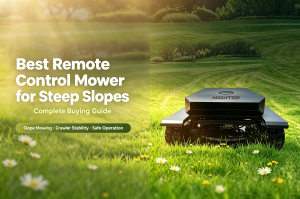
The Hightop HTM800PRO Remote Control Crawler Mower combines crawler-based mobility, remote operation and a dedicated vegetation-cutting system. This configuration is intended for applications where conventional mowing equipment may have difficulty maintaining traction or where it is difficult for the operator to work safely close to the machine.
For professional buyers, the correct mower should always be selected according to the actual combination of slope, soil, vegetation and working area.
If you are looking for a remote control mower for steep slopes, a crawler mower for orchards or an agricultural remote control mower for difficult vegetation management, review the HTM800PRO product information or contact Hightop with your working conditions.
Our engineering team can help evaluate your application and recommend a suitable machine configuration based on the terrain and vegetation conditions.
Conclusion
A professional remote control mower can work on steep slopes because several mechanical systems are designed to operate together.
The crawler system provides traction, the machine structure manages stability, the hydraulic system controls power transmission, and the cutting system converts engine output into useful mowing performance. Remote control technology then allows the operator to control the machine from a safer position.
For professional buyers, the key is therefore not to select a slope mower based on horsepower alone. A better approach is to evaluate the complete machine against the actual terrain, vegetation and operating requirements.
Hightop is committed to providing practical agricultural machinery solutions for demanding working environments. If you are looking for a remote control crawler mower for steep slopes, orchards, farms or other difficult terrain, contact Hightop and share your application requirements with us. Our team can help you identify a suitable equipment solution based on your working conditions.