Comparing Terrain Capability, Safety, Productivity and Operating Costs
A remote control mower vs traditional lawn mower comparison is not simply a matter of choosing between two different mowing machines. The two types of equipment are designed around different operating conditions.
Traditional lawn mowers are generally most effective on relatively flat, accessible areas where the operator can safely work close to the machine. Remote control mowers, particularly tracked models, are designed to extend mowing operations into areas where conventional equipment may have limited traction, access or operator safety.
For professional agricultural machinery buyers, the better choice depends on the terrain, vegetation, working area and required productivity rather than engine power alone.
1. The Main Difference: How the Machine Interacts with the Terrain
The fundamental difference between the two machines is their approach to mobility.
A traditional lawn mower typically relies on wheels and is designed for relatively firm and accessible ground. This makes it practical for lawns, parks, gardens and other areas where terrain conditions are predictable.
A remote control crawler mower, on the other hand, uses tracks to distribute machine weight over a larger contact area. This can improve traction and reduce ground pressure when working on uneven, soft or sloped terrain.
The difference becomes particularly important when the machine needs to operate on slopes.
A wheeled mower may have sufficient power to move, but power alone cannot prevent wheel slip or maintain stability when ground conditions become difficult. A tracked machine is designed to provide a more stable interface between the machine and the terrain.
This is one of the main reasons remote control mowers are increasingly considered for difficult agricultural and vegetation-management applications.
2. Which Mower Is Better for Steep Slopes?
For steep terrain, a purpose-designed remote control crawler mower generally has a significant advantage over a conventional lawn mower.
On a slope, the machine must overcome gravity while maintaining sufficient traction. At the same time, the operator needs to remain in a safe position.
A traditional mower places the operator close to the machine, which can become a major limitation as the slope becomes steeper or the terrain becomes less predictable.
A remote control mower separates the operator from the immediate working area. The machine can move across the slope while the operator controls it from a safer observation position.
However, buyers should not judge slope capability by a single maximum angle. Actual performance depends on ground conditions, vegetation, machine weight distribution, track design and the direction of travel.
If you are comparing different mower configurations for steep, uneven or sloped terrain, see our Steep Slope Mowers Selection Guide for a more detailed equipment selection framework.
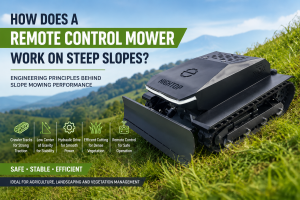
For a deeper explanation of the engineering principles involved, see our How Does a Remote Control Mower Work on Steep Slopes? article.
3. Safety: Operator Location Matters
Safety is one of the clearest differences between the two equipment types.
With a traditional lawn mower, the operator normally remains directly on or beside the machine. This is reasonable when mowing a flat lawn, but the risk profile changes when working on steep slopes, embankments, roadside vegetation or uneven agricultural land.
A remote control mower allows the operator to maintain distance from the cutting area and the machine itself.
This does not mean that remote control technology makes a machine mechanically stable under every condition. Instead, it reduces the operator’s exposure to hazards associated with difficult terrain and moving machinery.
For professional contractors, municipalities and agricultural operators, this distinction can be important when evaluating equipment for repeated work on slopes.
4. Cutting Performance and Productivity
Traditional lawn mowers can be highly efficient when working in their intended environment.
On a flat, open lawn, a conventional machine can often move quickly and provide a simple, economical mowing solution. There is little reason to use a specialized remote control machine when terrain does not create a significant operational challenge.
The situation changes when vegetation is dense or the ground becomes difficult.
A professional remote control mower can combine controlled low-speed movement with a dedicated cutting system, allowing the machine to maintain traction while dealing with uneven vegetation.
Productivity should therefore be measured by usable working time and area covered under real conditions, rather than maximum travel speed alone.
A machine that moves quickly on flat ground but requires frequent repositioning or cannot safely enter difficult terrain may have lower practical productivity than a slower machine that can continuously work in the required area.
5. Remote Control Mower vs Traditional Lawn Mower: Key Differences
| Factor | Remote Control Mower | Traditional Lawn Mower |
|---|---|---|
| Flat lawns | Suitable | Excellent |
| Steep slopes | Strong advantage | More limited |
| Uneven terrain | Very suitable | Depends on machine |
| Soft or wet ground | Tracked models can offer advantages | Wheel slip may become a problem |
| Operator exposure | Operator can work from a safer distance | Operator stays close to machine |
| Maneuverability on difficult terrain | High | Generally lower |
| Initial investment | Usually higher | Usually lower |
| Complex vegetation management | Suitable for demanding conditions | Depends on mower type |
| Best application | Slopes, orchards, farms and difficult terrain | Lawns, gardens and accessible areas |
The table shows why there is no universal winner.
The important question is not which mower is better in general, but which machine is better for the actual working environment.
6. When Is a Traditional Lawn Mower Still the Better Choice?
A traditional lawn mower remains the logical choice for many applications.
If the working area is flat, the ground is firm, access is easy and the operator can safely work close to the machine, a conventional mower may provide better economic efficiency.
There is little benefit in using specialized tracked equipment for a simple lawn-maintenance task if the additional terrain capability is not required.
This is an important consideration for professional procurement. Specialized equipment should be purchased because its additional capabilities solve a real operational problem, not simply because it has more advanced technology.
7. When Should You Consider a Remote Control Mower?
A remote control mower becomes more attractive when conventional equipment begins to encounter limitations.
Typical examples include steep agricultural slopes, orchard areas, roadside embankments, uneven grassland and vegetation-management sites where operator access is difficult.
In these environments, the value of the machine comes from the combination of crawler mobility, controlled power transmission and remote operation.
For example, an orchard may have relatively moderate slopes but still require the mower to maneuver between trees and across irregular ground. In this case, maneuverability and traction may be more important than maximum mowing speed.
The same principle applies to professional landscaping and vegetation-management contractors who need to work repeatedly in areas that are difficult for conventional equipment to access.
8. How Should Professional Buyers Make the Decision?
The most reliable purchasing method is to start with the working conditions rather than the machine specifications.
First determine the slope, soil conditions, vegetation density and available working space. Then consider whether the operator can safely remain close to the machine.
If the majority of work is performed on flat and accessible ground, a traditional mower may provide the better cost-to-productivity ratio.
If the work involves steep slopes, uneven terrain or areas where operator access creates a safety concern, a remote control crawler mower can provide capabilities that a conventional mower cannot easily offer.
Purchase price should also be considered together with long-term operating costs. Maintenance, wear components, spare parts, productivity and the number of working hours per year can all influence the actual cost of ownership.
9. Hightop Remote Control Crawler Mower
Hightop develops agricultural machinery for applications where terrain and operating conditions require more than conventional mowing equipment can provide.
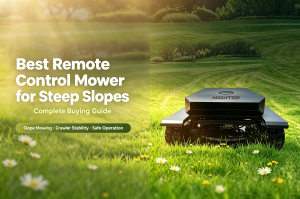
The Hightop HTM800PRO Remote Control Crawler Mower combines tracked mobility, remote operation and a dedicated mowing system for demanding vegetation-management environments.
It is particularly relevant to professional users who need to work on slopes, uneven agricultural land, orchards and other areas where operator access and machine traction are important considerations.
The right choice should always be based on the actual working environment rather than simply comparing engine power or purchase price.
If you are evaluating a remote control mower for steep slopes, agricultural vegetation management or difficult terrain, contact Hightop with your application requirements so the appropriate machine configuration can be evaluated.
Internal link: HTM800PRO Remote Control Crawler Mower → 链接到你的产品页
Conclusion
The comparison between a remote control mower vs traditional lawn mower should ultimately be based on application rather than technology alone.
Traditional lawn mowers remain highly effective for flat, accessible areas where operating conditions are simple. Remote control crawler mowers become more valuable when the job involves steep slopes, uneven terrain, difficult vegetation or increased operator-safety requirements.
For professional buyers, the key question is therefore not simply “Which mower is better?” but:
“Which mower can perform the required work safely, efficiently and economically under the actual terrain conditions?”
That approach leads to a more reliable equipment decision and helps ensure that the machine’s capabilities match the real working environment.
Hightop provides remote control crawler mower solutions for agricultural, landscaping and vegetation-management applications. If you have a specific terrain or mowing requirement, contact our team to discuss a suitable equipment solution.